Uncategorized

Drawings as a basis

For years, drawing has been a basic element of my paintings.  As I’ve explained earlier, I often draw onto the blank canvas, most often with charcoal, before working into it with acrylic paint.

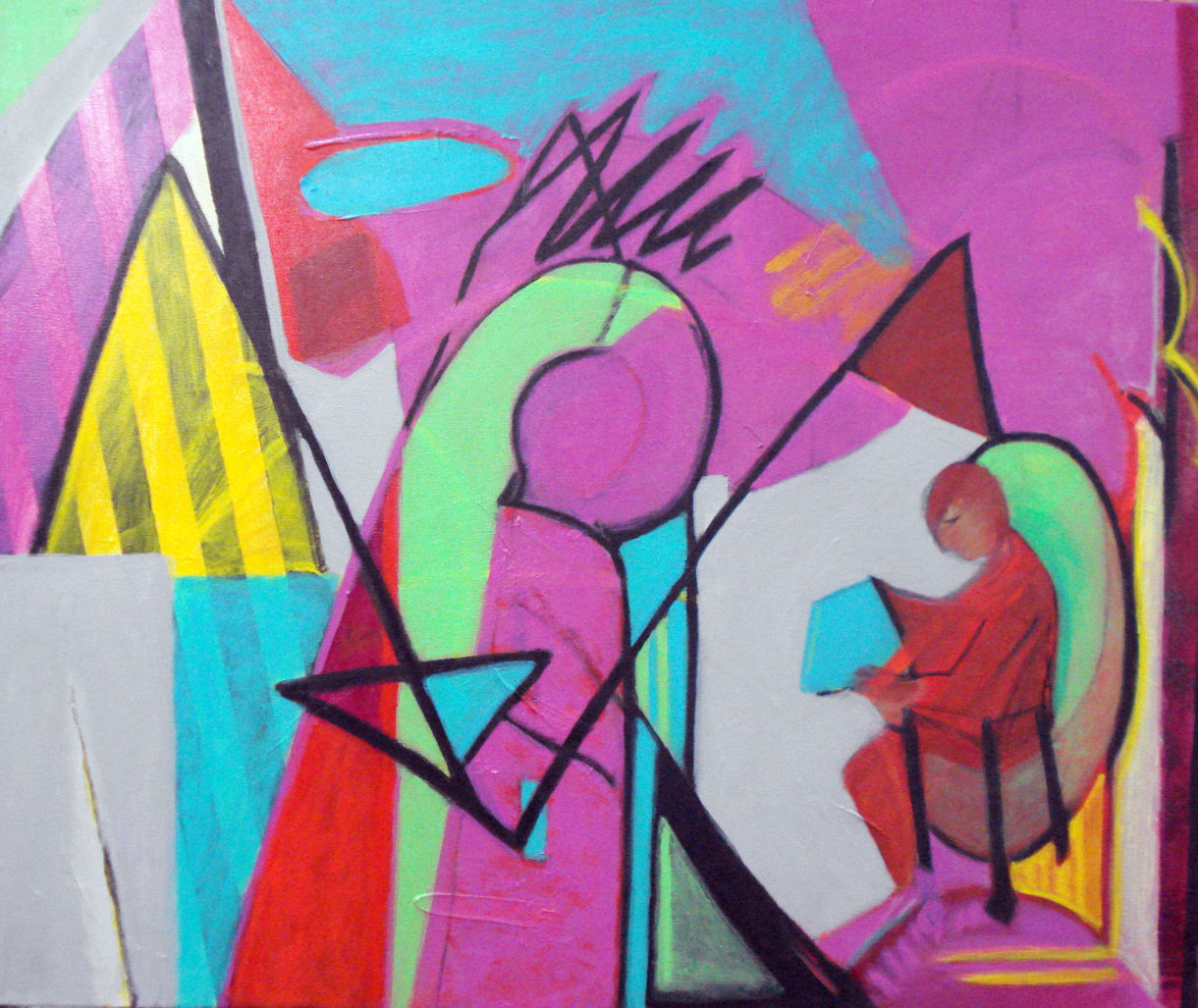
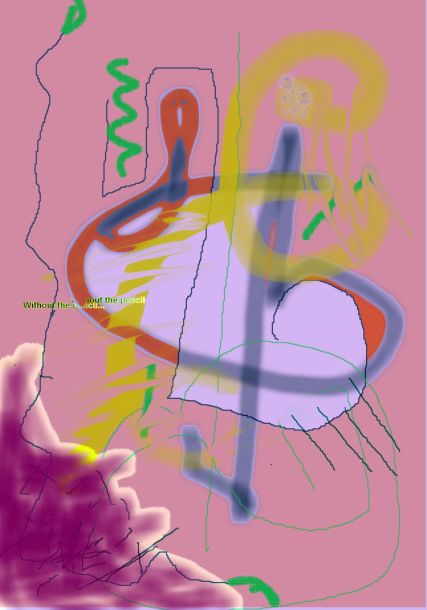
I’ve been looking carefully at some of the much smaller stand alone drawings I’ve done over recent years, and I’ve noticed changes in emphasis and even in materials occur. Some years I worked quite a lot with computer drawings….such as the following…

FSFA6.Image30

done probably about 2009.

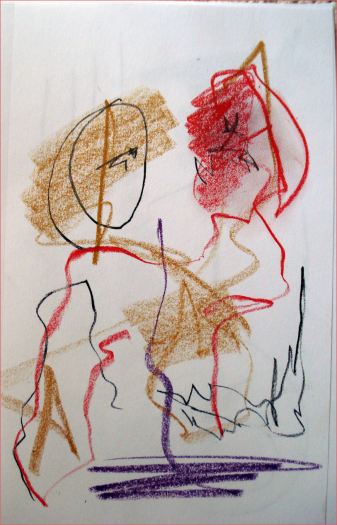
More recently I’ve concentrated more on slightly more figurative drawings, hand drawn on paper.  Such as:

pastel.c.20120921_3

This drawing is pastel and china marker on paper.

Each ‘series’ of drawings has different effects on the paintings I’m doing at the time. Not in the sense of being a direct influence, but in terms of mind-set? I guess I’d call it.

In the next blog I want to think a bit more about the interactions between the way of drawing and the way of making paintings….it is related, but not easily described.


Standard
Uncategorized

Recent News

Wisdom and Scholar.  a  8.27.15..DSC05319Hi All –

My how time flies!  So much has happened in the last 6 months!  I’ve been concentrating heavily on learning more about the business side of being an artist…and what a lot of time that takes!  I’ve attended quite a number of related webinars – Barney Davey, Jason Horesj and earlier, MIchael Hyatt….all very much to the point, very useful.

I now have a website:  www.patpaxson.com, as well as an active Facebook Page:  PatPaxson — Mindful-Art. I’m now including several paypal/shopping cart options on the website.

I’ve read a number of interesting books – to discuss soon – sold a few paintings and been active in a gallery in Framingham, MA – the Fountain Street Fine Art Gallery.   The most recent excitement was having my work in the FSFA stand at the Boston ArtFair (Oct ’15).  Great fun to take a look at all the (international) collections of galleries, and to chat with excited enthusiastic buyers/interested people as they circulated around the stands.

Plans for the future include a solo show at the FSFA gallery in Sept 2016…. I’ve invited my UK artist friend Kim Pace to join me for an ‘international’ show….our work is related in some ways, and different in others – more news as plans develop.

Here is one of the paintings that was in the Boston ArtFair:   ‘Wisdom and Student’ …. reflects my interest in people, their interactions and moods….I’ll write more about that soon.

Meanwhile – love to hear from you!

Standard
Uncategorized

Back Again….

Wisdom and Scholar.  a  8.27.15..DSC05319Hello – I’ve been off the map (again) for some few months, busy with making paintings and drawings, and, importantly, setting up and getting used to a new website: http://www.PatPaxson.com,  which has paypal options for many of the wide variety of paintings as well as occasional drawings.

The main purpose of my blogs is an introduction to my painting practice, in spite of the fact that paintings are notoriously difficult to write about… a way to inform (or at least provide hints) about the ideas, energies and enthusiasms that surround the making of my work. A second purpose is to tempt you all out there to comment on, and take an interest in, the paintings and drawings – your comments are very welcome.

Multi-layered images, multi-layered both physically in paint and mentally in ideas, are what keep me painting. I’ve been painting for many years now, perhaps 35 or so, and it never gets dull!  Many of my ideas arise from other sources, books, other artists, etc.  so I will be referring to some of these sources as well.

More soon….

Standard
General

Experiment

I’m back, after taking some time off…


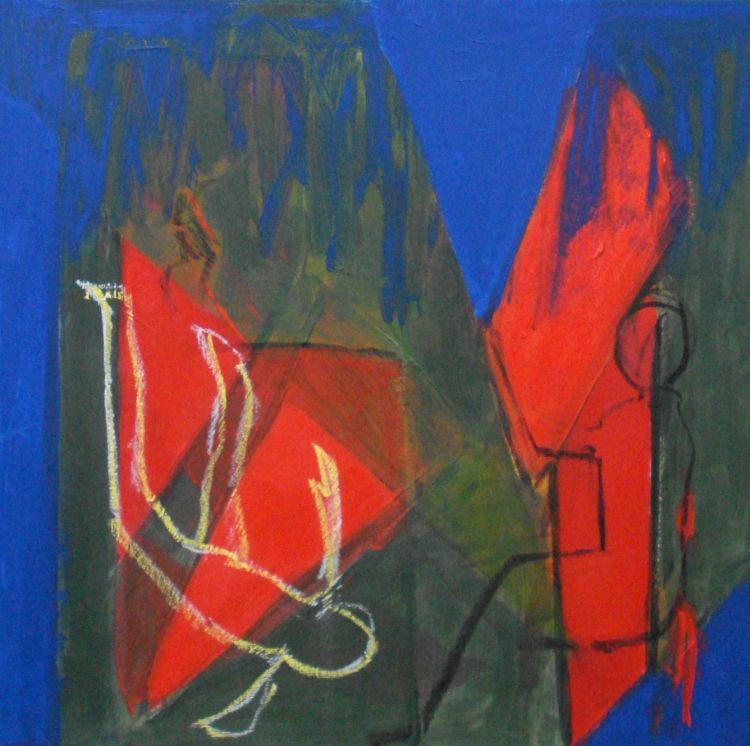
Here is an experiment. I call it an Inside Out Drawing, it is 16 x 12 inches, acrylic on canvas.

It is called an inside out drawing because, for me, drawing usually happens at early stages of making a painting, where layers of paint then move over/into/out from the original drawing/marks. So it feels strange to lay down on a bare canvas what will be not only a backaground of shapes and forms of various colors, but the basis for, or hints about, the drawing that will be made over the top of the colors.

In this case I find the figure on the right as we look at the painting especially intriguing in that it seems connected in some way to the clear red area underneath it – a bareback rider on a rushing horse?  Does that make the white figure a memory of former rides or a premonition of a fall about to happen…?  Someone is balancing (or alarmed) in the upper left quadrant.  There is lots of motion and movement indicated…the red energy is somewhat calmed by the blue.  As usual, there are multiple ways of seeing and relating to this painting according to what it brings to mind for you the viewer.  

Next time I plan to briefy discuss a fascinataing book I’m reading..about imagination.   See you then.

Standard
General

My painting ‘ The Visitor’

This painting was finished a few years ago. I did not begin with either a subject or an image in mind.  I had an ’empty’ mind as I began making random marks with charcoal on a blank canvas. This is the way I worked for a long period of my painting practice. It is typical of the work I was doing at that time (as opposed to the more recent period). It is part of what entrances me about being a painter: making abstract and random marks, ‘seeing’ an image; enhancing the image to be (somewhat) more legible, so that then the entire painting evolves, develops, grows from there. Spontaneity is important to me – as well as developing a painting which includes hints and glances (not descriptive details) of people and their moods and relationships.

In this painting there is a figure apparently in bed and another who is an on-looker. I love the feeling that the visitor is interacting in some positive way with the figure in bed…As I finished the painting I was hoping that people who saw the painting would feel this aspect of empathy or loving care. There are not many hints, but one is the postures of the two figures, another is that one can see their eyes seemingly connecting to each other.  My feeling is that it is a painting about compassion and caring. In several ways it was a struggle for me to get to that point: the overall aspect is abstract, so how to focus on details that would result in this feeling; how to give hints of the interation without including distracting particular details. I would love to hear your opinions…An earlier painting about caring...This painting is 30 x 40 inches.

Standard
General

An older painting re-visited


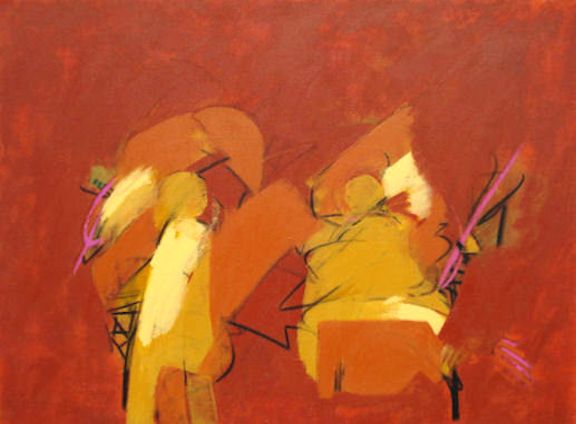
Every once in a while I come across one of my older paintings and think – I wish that looked a bit different.  This happened last week, when I was looking at a painting I made in 2009. I’ve always liked the painting except for one thing: the background was one solid color called ‘irridescent bronze’. I love the color and in general I like irridescent colors.  However in this case my eye was always distracted by the way the marks made by the brush in the background reflected the light in a distracting way…these brush marks were distinct and irregular. This made the background ‘active’ and interfered with and detracted from the marks describing the three people in the painting.  So I added color. You can see the result below. It turned out to be a good idea because the 3 figures emerge more strongly (although still mysterious) and the overall painting is much livelier.  There are still hints of the irridescent bronze, but in general the yellow ochre and mars yellow have resulted in a much clearer firmer painting.  The hints of the three heads are a bit more obvious – one still needs to spend a bit of time looking, but in my view that pays off by beginning to appreciate the ‘moods’ of restless but warm colors and the ‘distancing’ of the 3 figures which may relate to each other, but which are to some extent blocked from each other by the more dominant colors – a lack of ‘communication’ between them? or a ‘layering’ of the memories of one person?  The overall feeling is less one of introspection than one of a warm and active relationship.

So   acrylic on canvas, 30 x 40"

Standard
General

Some of my early ideas about drawing….

Recently I came across some notes I’ve accumulated (and forgotten to look at very often) about making the kind of drawings I like best:  ‘abstracted-figurative’, meaning that like my paintings, they include elements or hints of the human figure in an abstract drawing in such a way that the overall drawing is more easily imbued with ‘meaning’ or open to story telling.

a)  Think about numerous ways of making abstract marks….experiment for a while, then start a drawing on a clean piece of paper. 

b)  On canvas or paper, invent and make a series of various kinds of marks using graphite and/or charcoal. Include the use of an eraser (a good plastic one, or in the case of charcoal, a clean rag), as it makes ‘negative space’ marks.

c) Overlap and interlace some of these marks…spontaneously.

d) Look at the results with eyes half closed to see images emerge (as if looking at clouds for instance).

e) For me, the result is often touched by my own experiences and preferences – in other words autobiographical to one extent or another, as seen, for instance, in the previous blog about the ‘Black Swan’ painting.  For me it often touches on my interest in energies of personal space and interactions between people.  Try it!  It’s quite fun!!!

Standard
General

Thinking about the “Black Swan and Memories”

acrylic on canvas, 30 x 40"   

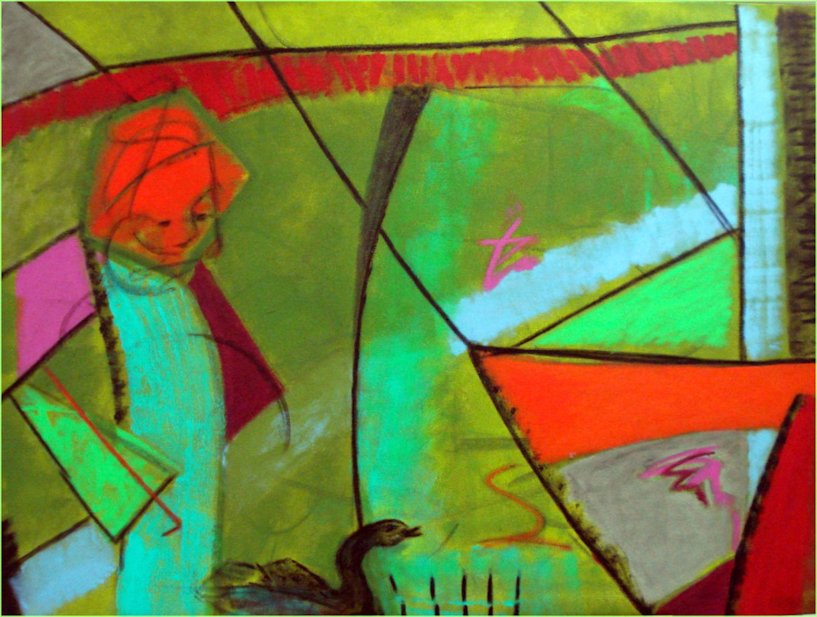
                                                    One driving interest in the painting ‘Black Swan’ is my passion for color.  As with many of my paintings, I began with no clear view in my mind of either subject or composition. Instead I began with multiple spontaneous and abstract marks with black charcoal on the primed canvas.  I rarely use the very first marks, instead I erase at random, and make more spontaneous marks.

At some point I see indications of figurative elements.  At the same time I add areas of color, often chosen at random.  Here the red and maroon against the green and turquoise work together as exciting and energetic.

Both composition and certain figures began to emerge, and I began to work on a painting that I could get my mind around, as opposed to working ‘blind’ as I did at first.  The appearance of the black swan reminded me of living in Geneva, Switzerland, quite some time ago, when we used to meet for a  sandwich lunch on a beach at the Lake of Geneva and watched the swan and their babies. In Australia, when I was there several years ago I visited a lake populated by a large flock of black swans – it was novel, intriguing and mysterious. More recently neighbors kept a pair of black swans on a small lake near us – paired for life and apparently glad to be fed by the people who imported them.   So for me the idea of ‘swan’ has many resonances:  travel, unusual places, good friends. Of course other viewers have quite different reminiscences, and I enjoy hearing about those too.

As well as the swan there are other figures in the painting.  There is the front bow of a boat inserting itself into the picture. Small boat sailing was a big part of our childhood, boats can indicate travel. This boat, like the swan, assumes a body of water, which is also emphasized by the streaks of blue (reflections, sky, or water? Or all?  And the person: as the painting began to come together, I first saw her contemplative face as she watches the swan. There are hints of the rest of her body in the abstract combination of lines and colors.  As the painting progressed, I began to see her as nearly translucent. She is ambiguous enough to attract various interpretations and associations depending on the viewer’s mood, interests and background.  There is an interesting ambiguity here: where is the girl standing if the swan is in the water?  Or is she just a dream, or a memory?  For me sometimes she is the focal point of the painting, sometimes it is the black swan.  This painting continues my interest in people, their moods and personal energies – here the girl appears to be contemplating either memories of the paast or hopes for the future…she is alone except for the black swan.

I also enjoy the ‘geometry’ of the painting – sometimes the strong black vertical lines add a mesh-like flatness, sometimes the lines combined with the colors give the appearance of space, where the space over the boat is closer to us than the space over the girl – the swan spans the two ‘spaces’.  A more puzzling aspect is the red streak across the top of the painting.  I am happy to have it there for at least two reasons…it adds energy and intention to the painting and it also serves to hold the image together.

Standard
General

Thinking about Pat Paxson’s painting ‘Meditation’

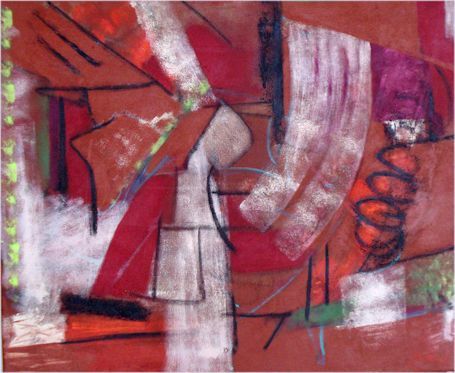
Pat Paxson's paintingPat Paxson’s painting ‘Meditation’ began as a layer of charcoal marks and energetic lines on the primed canvas.  Then I stopped to sit quietly looking:  I could see shapes and energies  – in this case a quiet figure of a person (in white) and the energy of the black marks, including the spiral in front of the figure. The dark red was applied as a background color, and some of the black marks were allowed to surface on top of the ‘background color’.

The person in white is the focal point of the painting, but the energy of other marks suggests not only a meditative state but the eruption of other thoughts at the same time – basically levels of energy. The figure’s bowed head indicates she is allowing those thoughts to swirl but is maintaining her mindfulness.

I especially love the rich background color, the accent and rhythm of the whites, the black spiral, as well as the space and depth resulting from the interaction of marks and colors.

Earlier I said:  ‘an indication of the light and the quiet joy’.


Comments always welcome.

Standard
General

Talking about space….in art

In Robert Genn’s letter of 5/3/13 he writes about something close to my heart – the occurance of space in a painting, in any number of ways ( I quote with his permission):

He says  “Fact is, a blank space may be the much needed rest period that comes before the action. It may also be the part of the work that sends the viewer yawning. A bit idiosyncratic and certainly not for everyone, I make actors of my blank spots, especially the interminable ones.  Spaces can often be gradated, blended, softened, hardened or at least formed into a strong negative area. Spaces also need nearby busyness to be effective in their spaciousness, just as sophisticated neutral tones and grays are needed for the surprise and excitement of nearby colour.”

This first sentence is the one I like the best:

“To my eye, paintings and other art take their strength from a calculated dance in which the various elements come together, interact, and move apart. No matter what the subject matter or motif, abstract style or realistic, negative and positive spaces contrive to juxtapose in a way that engages the viewer’s eye. Like a lot of art concepts, this isn’t the only way to go but it’s a valuable one.”


Standard